How to Find Your Niche: A Step-by-Step Guide to Choosing a Profitable Business Idea
Choosing a business niche can feel like one of the biggest decisions you will make as a new entrepreneur.
What if you choose the wrong idea?
What if nobody is interest in what you want to offer?
What if the market is already too crowded?
And what if you have so many interests that choosing just one feels nearly impossible?
These questions stop many aspiring business owners before they ever get started. Instead of testing an idea, creating an offer, or sharing their knowledge, they spend months trying to discover the one “perfect” niche that will guarantee success.
I am here to give you the truth: you do not need to uncover one magical business idea that you will be required to follow forever.
You just need a starting point.
The right niche sits at the intersection of what you are interested in, what you know or are willing to learn, what people actually need help with, and what has the potential to support a real business.
Finding your niche is not about predicting your entire future. It is about choosing a direction that is clear enough to test, develop, and grow.
In this guide, you will learn:
- What a business niche is
- Why choosing a niche makes business growth easier
- How to identify your interests and valuable skills
- How to find problems people will pay to solve
- How to research and validate market demand
- How to define your ideal customer
- Which online business niches may offer profitable opportunities
- How to avoid common niche-selection mistakes
By the end, you will have a practical framework you can use to choose a business niche with more confidence and less overthinking.
What Is a Business Niche?
A business niche is a specific segment of a larger market that your business serves.
It describes the type of person you help, the problem you solve, the outcome you help create, or a combination of all three. The more clearly you are able to define who you serve and how to help them, the easier it becomes for potential customers to understand whether your business is relevant to them.
Broad Market vs. Specific Niche
A market contains many different audiences, needs, products, and business models. A niche gives your business a clearer focus within that larger market.
Examples:
|
Broad Market |
More Specific Niche |
|
Business |
Business planning for first-time female entrepreneurs |
|
Fitness |
Low-impact home workouts for busy mothers |
|
Education |
Printable reading activities for early elementary students |
|
Travel |
Budget-friendly family travel planning |
|
Marketing |
Email marketing for beginner digital product sellers |
|
Organization |
Home organization systems for working parents |
|
Finance |
Simple budgeting systems for self-employed women |
You do not necessarily need to choose the narrowest niche possible. Your niche simply needs to be specific enough that the right people recognize themselves in your message.
A Simple Niche Formula
You can begin defining a niche with this formula:
I help [specific audience] solve [specific problem] so they can achieve [desired result].
Overtime, your statement may change as your gain experience. For now, it gives you a helpful starting point for your business, products, and marketing.
Why Choosing the Right Niche Matters
Choosing a niche does not mean excluding everyone outside of it. It means making your message more relevant to the people you are best positioned to help.
When you try to speak to everyone, your content can become too general. Potential customers may not understand why they should follow you, trust you, or purchase from you. Having a defined niche can help make many parts of your business easier.
Your Marketing Becomes Clearer
Without a niche, you could possibly struggle trying to explain what your business even does.
One day you could be sharing social media trips and the next posting about budgeting, a parenting tip, recipe, etc. Which each topic could be useful, the overall message can feel disconnected.
Once you choose a niche, you can create messaging around a consistent audience and problem.
Content Ideas Become Easier to Find
One of the biggest benefits of choosing a niche is that your audience starts telling ‘you what content to create.
Instead of sitting down every week thinking, What in the world should I post about?, your audience’s questions become your content strategy, giving you an entire content ecosystem.
SEO Becomes More Focused
Search engines need context to understand what your website is about. So having a niche, gives your website a clearer topic structure. When you consistently publish high-quality content around related subjects, it becomes much easier to create a connected library of resources.
Pinterest Becomes More Strategic
Pinterest works like a visual discovery and search platform. People frequently use it to plan projects, solve problems, and find ideas. A defined niche allows you to create keyword-focused Pinterest boards, pin designs, titles, and descriptions that relate to one another.
With this, you give your Pinterest account a more consistent focus and it helps the right audience understand what they can expect from your content.
Your Products Become Easier to Create
Hands down, my favorite reason to choose a clear niche. Once your understand you audience’s journey, you can start building products around the problems she experiences at each stage.
People Understand Why They Should Choose You
Think about the last time you searched or help with a very specific problem. You probably didn’t want something vague. You wanted something that felt like it was created for you exact situation.
The same thing happens with your customers.
For example:
If you are a virtual assistant creating your first service packages, which product sounds more useful?
A General Business Workbook
or
The Virtual Assistant Service & Pricing Workbook
The first one could be helpful, but the second one feels like it understand exactly what you are needing.
That is the power of specificity.
Common Myths About Finding Your Niche
Before we get into the actual steps for finding your niche, there are a few ideas I want you to let go of. Sometimes the biggest thing keeping you stuck is not your lack of ideas, but the pressure you are putting on yourself to get the decision absolutely perfect.
Myth #1: “I have to find the perfect niche”
Actually, you do not. There is no a perfect niche, if I am being quite honest with you.
Every niche will have advantages, challenges, competitors, and things you will need to learn. What you are truly looking for is a strong idea worth testing.
That is a much more realistic goal. You can research for three months and still have unanswered questions. But, a few conversations with potential customers can quickly show you whether your idea has potential.
Myth #2: “i can only choose one thing i love”
Your niche is not your entire personality. You are allowed to love more than one thing.
Maybe you love:
- Business
- Organization
- Parenting
- Travel
- Design
- Education
That does not mean you need to somehow cram all six into one business, but, it simply means you have options.
Sometimes your best niche may even come from combining two related interest.
For example:
Business + Organization could become:
Business systems and productivity for female entrepreneurs.
Parenting + Organization could become:
Home management systems for busy moms.
You do not need to limit yourself, you simple need to give your business a clear direction.
Myth #3: “i need years of experience”
You may already have more valuable experience than you even realize.
Think beyond the formal business experience. Your knowledge could come from:
- Your career
- Your education
- Raising a family
- Managing a household
- Planning events
- Organizing systems
- Helping coworkers
- Learning a creative skilll
- Volunteering
- Managing budgets
- Building a hobby
- Solving a problem in your own life
Sometimes we dismiss skills because they feel normal to us. You could think that everyone knows how to do something but sometimes they truly don’t. Something that can feel simple to you may be exactly what someone else is struggling to understand.
myth #4: “the market it already too saturated”
I have struggled with this in the past but competition can actually be a very good sign. If people are already creating content, selling products, running courses, and offering services in a niche, that often means customers are interested in spending money there.
So, the question is not, “Is somebody already doing this?“
The better questions are:
- Can I serve a specific audience?
- Can I explain it more clearly?
- Can I make the process easier?
- Can I create a better experience?
- Can I offer a different format?
- Can I speak to beginners?
- Can I bring my own perspective?
You do not need to invent an entirely new market. You just need to find you place within an existing one.
myth #5: ‘i have to be the expert”
You should always be honest about your experience and stay within your professional limits. But, you do not need to know everything in order to help someone. Sometimes it as simple as being several steps ahead.
For example: Say you learned how to create a digital product, you may be able to help someone who has never created one before.
You can teach someone what you genuinely know without pretending to be something you are not.
myth #6: “i will be stuck in this niche forever”
No, you do not need to be stuck in a niche forever. Your niche is allowed to evolve and most businesses do just that. You might discover that one product category sells better or you may realize that you love serving one specific type of customer.
Information like that helps you refine your business.
You are not signing a lifetime contract. You are simple choosing your next direction.
How to Find Your Niche In 6 Steps
Are you ready to stop circling the same idea and finally start narrowing things down? Use this simple process:
- Start with your interest.
- Identify your skills and experience.
- Find problems people need solved.
- Research market demand.
- Validate your niche.
- Define your ideal customer.
You can easily work through these steps in one weekend or spread them out over a couple of weeks. The most important part, when working through these steps, is taking note of all your answers. Keeping everything in your head can make the process feel much more confusing than it needs to be.
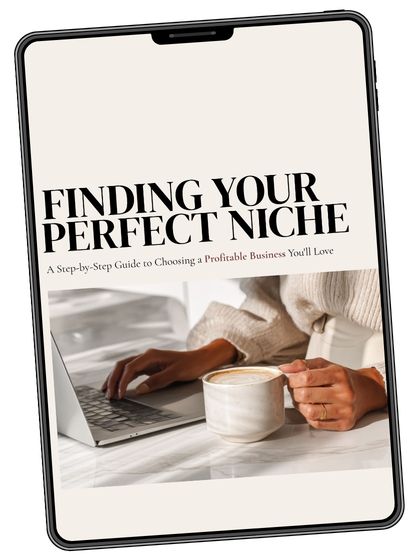
Workbook
Finding Your Perfect Niche
Go from “I have no idea what my niche should be” to a clear, confident business direction with a guided workbook designed to help you explore, research, and validate your perfect niche.
Step 1: Start With Your Interest
Let’s begin somewhere easy. What do you actually enjoy?
Your interest are not the only thing that matters when choosing a business niche, but they definitely deserve a place in this conversation. You could spend years creating content and products around this topic. So, it can help if you are genuinely curious about the topic.
ask yourself these questions?
Take sometime to ask yourself the questions below without trying to make them “business worthy.”
- What topics can I talk about all day?
- What do I naturally search for online?
- What do I enjoy helping people with?
- What type of problems do I like solving?
- What do I enjoy creating?
I dive deeper into these questions in, “Finding Your Perfect Niche“, but these are the top questions that you need to be answering for yourself. Don’t put too much pressure on these answers, this is basically considered “brainstorming”.
create an interest inventory
Divide your paper into four sections:
- Topics I enjoy
- Activities I enjoy
- People I enjoy helping
- Results I like creating
Step 2: Identify Your Skills and Experience
In this section, you are going to take a closer look at what you already know. Please don’t dismiss a skill simply because it comes easy. This is one of the biggest mistakes that people can make when brainstorming business ideas.
Start with your career
Write down each responsibility you have had in your professional life.
For example, let’s say you worked in administration, you might have experience with:
- Scheduling
- Process improvement
- Custom communication
- Training
- Documentation
- Organization
- Project coordination
- Managing teams
- Creating procedures
- Problem-solving
and those skills can translate into:
- Virtual assistant services
- Business templates
- Operations consulting
- Project management tools
- Productivity systems
- Online courses
Think about your personal experience too
Life has taught you things also. Maybe you learned how to:
- Manage a busy household
- Create routines for children
- Organize a small home
- Plan a wedding
- Use Canva
- Grow on Pinterest
- Build a family budget
The list goes on.. just remember you want to stay within appropriate professional boundaries, especially when it comes to topics like health, law, or finances.
But knowing your personal experience can absolutely help you understand a particular customer.
look at your education and training
Your knowledge can also come from:
- College
- Certifications
- Workplace training
- Online courses
- Independent research
- Software you learned on your own
Don’t underestimate your self-taught skills. Entrepreneurship is full of people who build valuable knowledge by learning, practicing, experimenting, and improving over time.
ask people what your good at
Go around asking the people that you know what you are good at. Honestly, you might be surprised by their answers. Sometimes other people can see our strengths much more clearly than we can.
A Little Business Support, Right in Your Inbox ♡
Get beginner-friendly business tips, helpful resources, new blog posts, freebies, and first looks at what’s coming to Templates & Toolkits—delivered straight to your inbox.
Step 3: Find Problems People Need Solved
This is where your idea begins turning into a potential business. Businesses are meant to help solve problems, and those problems don’t always have to be huge.
An problem could simple be:
“I have no clue what to post on Instagram.”
“I need activities to keep my preschooler learning at home.”
“I want to start a business, but I do not know what to do first.”
Each of these problems can support content, products, services, or education.
Look Beyond the Surface Problem
Often there is both a practical problem and an emotional problem.
Example:
Practical Problem: She cannot organize her content.
Emotional Problem: She feels inconsistent and frustrated every time she sits down to post.
Understanding both sides can help you create better products for your customer and better marketing.
Where Can You Find Real Problems?
Start paying attention to what people are already saying. Look at:
- Google searches
- Pinterest searches
- YouTube comments
- Reddit discussions
- Facebook Groups
- Blog comments
- Etsy reviews
- Amazon reviews
- Community forums
- Customer emails
- Social media comments
Pay attention when people say:
“How do I…?”
“I wish there was…”
“I am struggling with…”
Try This Problem-Solution Exercise
Choose one of your niche ideas and fill out these questions:
- Who is struggling?
- What are they struggling with?
- How does that problem make them feel?
- What result do they want?
- What could make that easier?
- What could I create to help?
Step 4: Research Market Demand
In this section, you start looking beyond what people would like and start looking for actual evidence.
You are looking for signs that people actually care about this topic.
Start With Google
Search your niche and notice what appears. Look at:
- Autocomplete suggestions
- People Also Ask questions
- Related searches
- Blog posts
- Videos
- Products
- Courses
- Businesses
- Ads
If Google gives you dozens of related questions, that tells you people are searching around the topic. Questions can later become:
- Blog posts
- Emails
- Pinterest pins
- Product ideas
- Course lessons
Search Pinterest
Pinterest can be especially helpful for visual and planning-based niches.
Type your topic into Pinterest and see what suggestions appear.
Look at:
- Keywords
- Board names
- Pin titles
- Popular themes
- Products
- Freebies
- Tutorials
Look at Youtube
When searching Youtube, search for the beginner questions within your niche.
Which videos have lots of engagement?
What are people asking in the comments?
What tutorials are people looking for?
You may notice that the same questions keep appearing and repeated questions usually mean there in an ongoing need.
Browse Communities
Reddit and Facebook Groups can help you understand how your audience talks.
Notice:
- What frustrates them
- What they have already tried
- What they are confused about
- What they wish existed
- Which questions appear repeatedly
Seeing these conversations can really help you understand your customer’s real language.
Research Etsy and Amazon
If your niche could support digital products, printables, planners, books, templates, or resources, spend some time looking at what people are already buying.
Read the reviews, see what the customers love, and what they complain about.
Sometimes your opportunity isn’t creating something new. It could be making something easier, clearer, prettier, more organized, or better suited to a specific audience.
Study Your Competitors Without Copying Them
Competitor research should make you smarter.
Start looking at:
- Who they serve
- What they sell
- How they position their offer
- What customers love
- What customers still need
- What feels complicated
- What feels missing
Then ask:
Where could I create something different or better suited to my audience?
Maybe your edge is:
- More beginner-friendly education
- A softer, more encouraging style
- Better templates
- Better organization
- A more specific audience
- A clearer system
- More affordable entry products
Your goal here is not to become somebody else’s business but to understand the market well enough to build your own.
Step 5: Validate Your Niche
Validation simply means finding evidence that people care enough about the problem to take action.
And no, you do not need a full website and 20 products before you validate.
Ask Yourself These Questions
Before you fully commit to a niche, ask:
- Can I clearly identify who I want to help?
- Do they have a real problem?
- Are they searching for solutions?
- Are people already spending money in this market?
- Can I think of at least 20 content ideas?
- Can I think of several potential products or services?
- Does this niche have room to grow?
- Am I interested enough to work on this consistently?
- Do I have relevant experience or a plan to gain it?
- Can I explain how my approach is different?
You do not need a perfect “yes” to every question. You are just looking for enough positive signals to test the idea.
Run a Small Test
Instead of building everything first, try something smaller.
You could:
- Create a free checklist
- Publish a blog post
- Start a waitlist
- Share educational content
- Create a mini product
- Offer a beta service
- Ask people what they need
- Presell a product
- Host a small workshop
Then watch what happens. Do people:
- Sign up?
- Click?
- Reply?
- Ask questions?
- Download?
- Purchase?
- Join the waitlist?
Validate the Problem Before Perfecting the Product
You do not need to spend six months creating a 200-page workbook before you know whether people actually want it.
First validate:
- The audience
- The problem
- The desired result
- The solution
- The willingness to buy
Then build the polished version of the product. Your future self with thank you!
Step 6: Define Your Ideal Customer
Once your niche begins taking shape, you need to understand the person behind it.
You will want to understand:
- Where they are right now
- What they want
- What they are frustrated by
- What they have already tried
- What they are worried about
- What type of help they want
- What could stop them from buying
Create Your Ideal Customer Statement
Use this:
My ideal customer is a [type of person] who wants to [goal] but is struggling with [problem]. She needs [solution] so she can [desired result].
Example:
My ideal customer is an aspiring female entrepreneur who wants to build an online business but feels overwhelmed by all the decisions she needs to make. She needs clear, beginner-friendly guidance so she can move forward confidently without trying to figure everything out alone.
Once you complete this, you will have someone to write for.
15 Profitable Niche Ideas for Online Businesses
Before we get into these ideas, remember:
There is no niche that automatically guarantees profit.
A niche becomes profitable because of your audience, offer, positioning, pricing, marketing, and customer experience. Still, certain broad markets have ongoing demand because they contain problems people consistently want help solving.
Here are 15 areas worth exploring.
1. Business
You could help entrepreneurs:
- Start businesses
- Create business plans
- Build systems
- Launch offers
- Improve productivity
- Organize their operations
2. Productivity
People are always looking for ways to manage their time and responsibilities better. Possible directions:
- Time management
- Planning
- Goal setting
- Productivity for entrepreneurs
- Productivity for moms
- Project management
3. Marketing
Marketing contains many smaller niches:
- Pinterest marketing
- Email marketing
- Social media
- SEO
- Content strategy
- Branding
- Copywriting
4. Personal Finance
If you work in this area, stay mindful of the difference between educational resources and individualized professional financial advice.
Possible niches include:
- Budgeting
- Saving
- Debt organization
- Money tracking
- Financial organization
5. Health and Wellness
Health content requires extra care around claims and professional expertise.
Niches can include:
- Healthy routines
- Wellness planning
- Stress management
- Habit tracking
6. Fitness
You might focus on:
- Beginner workouts
- Home workouts
- Low-impact fitness
- Fitness for busy moms
- Strength training for a specific audience
7. Parenting
Parents consistently search for support around:
- Routines
- Activities
- Organization
- Meals
- Travel
- Education
This creates opportunities for blogs, printables, planners, courses, and memberships.
8. Education
Possible audiences include:
- Teachers
- Homeschooling families
- Tutors
- Preschool parents
- Elementary students
Products could include worksheets, lesson plans, activities, printables, and learning systems.
9. Weddings
Weddings involve an enormous amount of planning.
Possible offers include:
- Wedding planners
- Checklists
- Invitations
- Vendor trackers
- Budget templates
- Editable signage
10. Travel
You could specialize in:
- Family travel
- Budget travel
- Luxury Travel
- Specific destinations
- Packing
- Itinerary planning
11. Home Organization
This can include:
- Cleaning routines
- Decluttering
- Household management
- Family organization
- Printable home systems
12. Digital Products
You could help people:
- Find ideas
- Create products
- Design products
- Price them
- Sell online
- Market them
If this interests you, read 150 In-Demand Digital Products to Sell Online for even more inspiration.
13. Content Creation
You could focus on:
- Content calendars
- Social media planning
- Repurposing content
- Creator systems
- Writing prompts
- Brand messaging
14. Blogging
Possible topics include:
- Starting a blog
- SEO
- Content planning
- Affiliate martketing
- Traffic growth
- Monetization
15. Virtual Assistance
Possible areas include:
- Starting a VA business
- Finding clients
- Choosing services
- Client onboarding
- Pricing
- Specializing in a particular industry
Examples of Strong Business Niches
Sometimes it is easier to understand niches when you see them in action.
Use this format:
Broad Market → Specific Niche → Ideal Customer → Example Offer
Examples:
Business
- Broad Market: Business
- Niche: Business startup planning
- Ideal customer: Women starting their first online business
- Offer: Beginner business planning course with templates
Productivity
- Broad Market: Productivity
- Niche: Client organization
- Ideal customer: Freelancers managing multiple clients
- Offer: Client workflow dashboard
Digital Products
- Broad Market: Digital products
- Niche: Canva products
- Ideal customer: Beginners creating their first digital download
- Offer: Digital product starter workshop
Can you see how much clearer each business becomes as the niche gets more specific?
A Little Business Support, Right in Your Inbox ♡
Get beginner-friendly business tips, helpful resources, new blog posts, freebies, and first looks at what’s coming to Templates & Toolkits—delivered straight to your inbox.
Signs You Have Found The Right Niche
Your niche does not need to be “perfect” but it does need to feel strong enough for you to be able to move forward with the idea and test it.
Here is a quick checklist that can help you decide on moving forward:
- I know who I want to help
- I understand at least one problem they have.
- I know what result they want.
- People are searching for this topic.
- People are already buying related solutions.
- I could create at least 20 pieces of content.
- I can image several products or services.
- I have relevant skills or I am willing to learn.
- I genuinely enjoy this topic.
- I can explain what makes my approach helpful.
- The niche is not so broad that I am talking to everyone.
- It is not so narrow that I have nowhere within the niche to grow.
- I am willing to test it before expecting certainty.
If most of these are a YES, then that’s a good sign to move foward.
Common Mistakes to Avoid When Choosing a Niche
Some of the common mistakes that you should watch out for when choosing a niche are:
- Being to broad
- Being to narrow
- Following trends ONLY
- Ignoring demand
- Copying competitors
- Trying to help everyone
- Waiting for perfect clarity
FAQ About Finding Your Niche
How do I know if my niche is profitale?
A niche can have a strong profit potential when:
- There is a clear audience
- The audience has a real problem
- People search for solutions
- People are already buying related products or services
- You can create a valuable solution
No niche is actually guaranteed to make any money, but how you set up your offer and marketing matter.
Can I change my niche later?
Well, of course. Like I mentioned earlier, you are not tied down to your niche.
Businesses evolve all the time.
You may narrow your niche, expand it, or shift your audience as your learn more.
Changing your niche based on real information is not failure, it is business growth.
Can I have more than one niche?
Eventually, yes.
I would start with one main focus for now as you are just getting started. It’s easier.
It helps you concentrate on your:
- Content
- Products
- Marketing
- SEO
- Audience building
One you have the one direction working well, you can expand it a bit more.
How specific should my niche be?
It should be specific enough that the right customer knows you are talking to them but broad enough that you can still create plenty of content and products.
You are looking for balance.
Should I choose something I am passionate about?
Passion in your niche can help but passion alone is not enough.
A strong niche usually combines:
- Something you care about
- Something you understand
- Something people need
- Something people are willing to pay for
What if someone is already doing it?
That’s what you want! That can be proof that the market exists.
Your job is not to be the only person that is doing it, it is to create a version that feels useful, relevant, and trustworthy to your specific audience. Ya know?
How long should I take to find my niche?
Honestly, you don’t need to spend months deciding.
You should give yourself a reasonable deadline.
You can start by researching your strongest ideas, choosing one, and then testing it.
You will learn more by taking action than by endlessly thinking about taking action.
What if I have too many ideas?
Score each idea from one to five based on:
- Interest
- Experience
- Market demand
- Audience clarity
- Problem urgency
- Product potential
- Growth potential
Then research the ones that are in your top two or three.
What if I have no ideas?
If you have no ideas, then start with your own life.
List:
- Every job you have had
- Skills that you use
- Challenges you have overcome
- Topics you love
- Questions people ask you
- Things you have learned
- People you understand
You may be sitting on several different ideas and have no clue.
Your Next Step: Choose a Direction
I am so proud of you for making it this far. I hope that you feel a little lighter about choosing your niche.
Finding your niche is not about discovering the one perfect business idea that will determine your entire future. It is about choosing a thought starting direction that eventually lead you on the correct path that is perfect for you.
Look for the overlap between
- What you enjoy
- What you know
- What people need
- What people are searching for
- What could you realistically create or sell
Then choose your idea and start testing it.
Get out there and starting talking to people, publishing content, creating small resources, building a waitlist, etc.
Pay attention to what people click, ask, download, and buy.
You don’t have to know exactly where your business will be in the next five years, you just need enough clarity to take the next step… and then the next one.
That is how businesses are built.
Choosing Your Niche Is Only the Beginning
Once you finally choose your niche, you might feel an immediate sense of relief.
Well, for just a moment, and then a brand new list of questions appear.
Okay, now how do I actually turn this into a business?
You may start wondering:
- How do I validate my idea?
- Who exactly is my ideal customer?
- What should my brand look like?
- What should I sell first?
- Do I need a website?
- How do I grow my email list?
- Should I use Pinterest?
- How do I launch?
- What should I focus on first?
Bam.. and right there brings you back to 47 different browser tabs.
This is exactly why I created Business GPS.
Business GPS is designed to help aspiring and early-stage entrepreneurs move from:
“I have an idea, but I have no clue what comes next.”
to:
“I know exactly what I am building and what I need to work on next.”
Inside Business GPS, I will walk you through the bigger journey of building your online business, including:
- Choosing your niche
- Validating your business idea
- Defining your ideal audience
- Building your brand
- Creating your offers
- Developing your marketing
- Growing your email list
- Using Pinterest strategically
- Planning your launch
- Creating systems
- Growing with more confidence
Instead of trying to piece together your business from hundreds of random blog posts, videos, downloads, and saved Pinterest pins, you will have an organized roadmap you can actually follow.
Join the Business GPS waitlist to receive updates, behind-the-scenes previews, and early access when enrollment opens.
You do not need to have everything figured out today.
You just need a clear direction and a next step.
And if choosing your niche is the step you are working on right now, you are already moving forward.
Join the waitlist
Join The Business GPS Waitlist
Receive updates, behind-the-scenes previews, and early access when enrollment opens.